
When the File Server Died: Why On-Site, Same-Day Warranty Coverage Matters
The call came in the way these calls always do: the server was down, and nobody could get in.
For this client in East Ft. Lauderdale (name withheld), that one server wasn't just file storage. It was also running two virtual machines — one used by literally everyone in the company for their print and document cost-recovery platform, and a second one dedicated to a single department running a proprietary piece of software old enough that replacing it wasn't really an option. Three critical workloads, one physical box, and it had gone dark.
Ninety Percent Sure Isn't the Same as Sure
We quickly arrived on site, did our initial due diligence by reseating all components in the server, making sure all internal cards, cables, modules, memory, fans and power supplies were snug and had not come lose. Everything pointed out to a malfunctioning RAID controller. FYI the RAID controller sits between the hard drives and the rest of the computer, and without a working one, the computer simply fails to detect the hard drives and refuses to start the operating system. Our next move was to get on the phone with the manufacturer. In this case the manufacturer was Dell, though the story that follows plays out the same way with Dell, HP, Lenovo, or any of the other major server vendors. We walked their support team through the symptoms: the server wouldn't boot, and their diagnosis pattern also pointed toward a failed RAID controller. We & they were about 90% confident that was the culprit and had a dispatch number before we hung up.
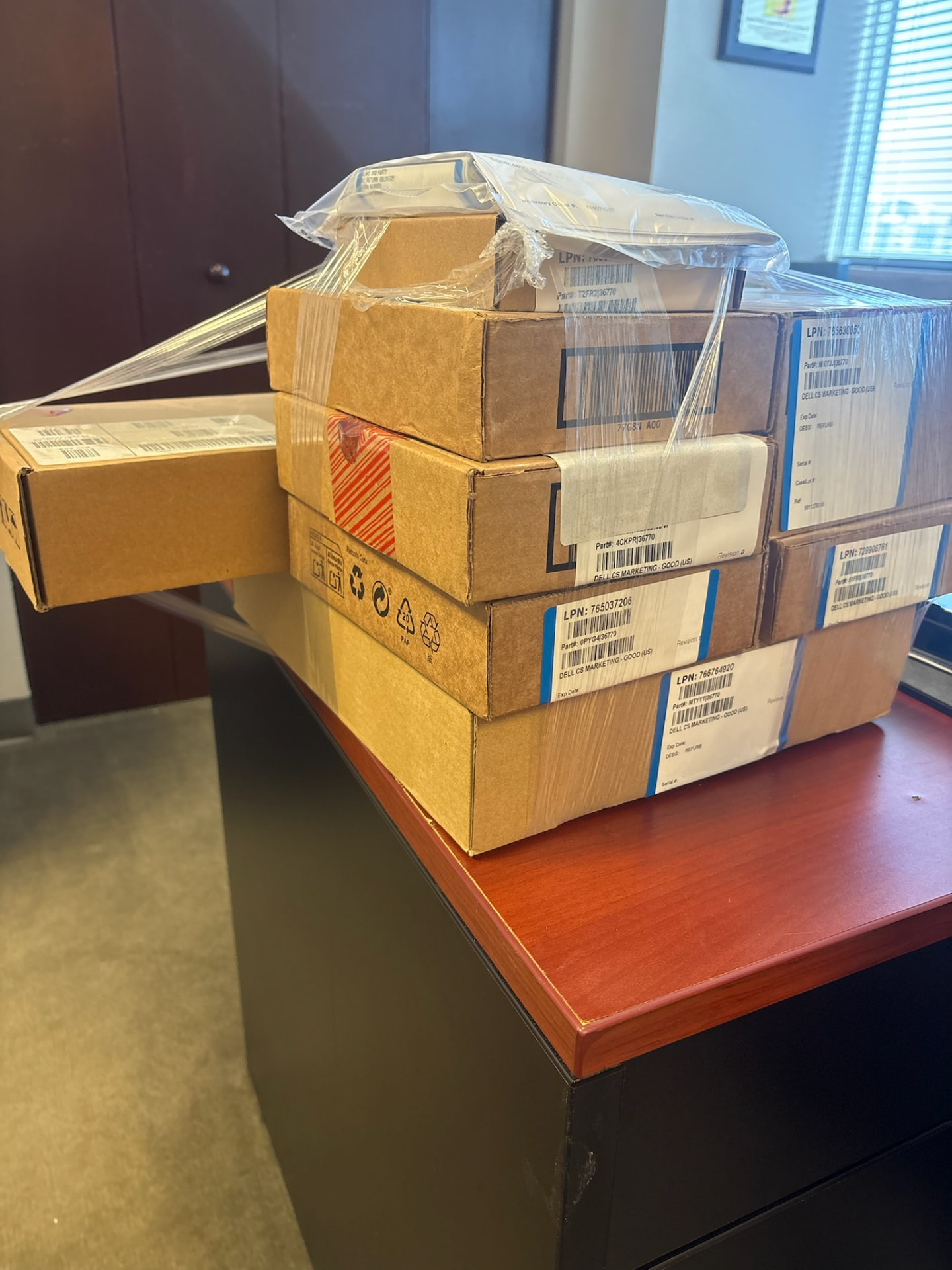
Here's the part that's easy to overlook: 90% sure isn't 100% certain. Dell didn't want to gamble on a second truck roll if we were wrong, or if a related component had failed alongside the controller. So they didn't just ship the RAID controller — they shipped everything that could plausibly be involved: a new mainboard, the drive backplane, a PCIe riser assembly, the power distribution board, the TPM module, thermal pads, cable harnesses, and the RAID controller itself.
What Showed Up Four Hours Later
Within four hours of hanging up the phone, a courier had dropped that entire pile (see picture) at the client's receptionist's desk. A technician followed about an hour after that, and not long after, the server was back up and both virtual machines were running again. Without that kind of same-day or next-day coverage, a failure like this could easily have kept the server down for a week or more. Just to let our readers know that major manufacturers keep inventory of most parts at either their own local depots or partner hubs, or simply utilize direct courier injections. This allows parts to arrive at customers' sites within a few hours, 24/7/365.
Why Servers Without Proper Coverage Never Works Out
Modern servers aren't generic PCs. Backplanes, riser assemblies, and power distribution boards are proprietary to a specific model, and almost always to a specific hardware revision. No local IT provider — no matter how good — can keep a warehouse stocked with the tens of thousands of parts it would take to cover every manufacturer's every model. It isn't possible, financially feasible, and it wouldn't be a responsible use of a client's money if we tried.
Without a dispatch relationship already in place, this same failure plays out very differently. Someone has to correctly diagnose which part or parts actually failed — not always obvious from the outside. Parts then have to be sourced directly from the manufacturer or a broker, often at premium pricing plus next-day-air pricing. If the diagnosis is wrong, or if more than one part is bad, that's another full day waiting on the next shipment. And if a part turns out not to be needed after all, there's no guarantee it can be returned, all the while racking up exorbitant charges on the client's credit card.
An active warranty coverage, with on-site, same- or next-day coverage moves all of that risk off the client's desk and onto the manufacturer's. That's the real value of the coverage — not the hardware itself, but who's holding the risk when something breaks.
Why This Server Wasn't in the Cloud
It's fair to ask why a business this dependent on one server didn't have failover, redundancy, or a cloud-hosted alternative. In our experience, it usually comes down to ordinary reasons. First, that department's legacy software predates cloud licensing — there's often no supported path to running decades-old, purpose-built software anywhere but on hardware the company controls directly. Second, a business this size typically doesn't have a dedicated compliance or security team to vet a cloud provider, so keeping data on hardware they can physically see feels safer, and a known capital cost is an easier number for ownership to plan around than an open-ended cloud bill. Third and final wrench in to the situation, is that the supplier of their cost-recovery software forces a local deployment, hence the need.
None of that is unreasonable. It just means the safety net has to come from somewhere else.
The Real Lesson
If a business is going to run critical infrastructure on-site without redundancy, an active hardware and software warranty isn't a nice-to-have — it's the failover plan. And it only works if it's actually in force. Coverage that lapsed six months ago because a renewal notice got buried in an inbox does nothing for you at 9am on the day the RAID controller dies.
This is exactly the kind of thing we track for clients: what's covered, what's expiring, and what needs to be renewed before it becomes a problem instead of after. If you're not sure where your infrastructure's warranty coverage currently stands, we'll take a look and tell you — no charge.